Exploring the Whimsical Charm of Cutebarbie Regular
A Typeface with a Playful Heart
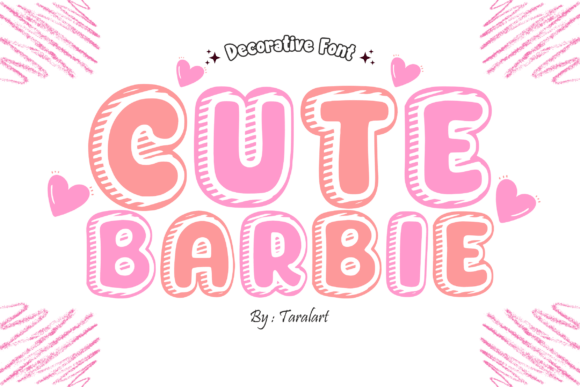
Cutebarbie Regular isn't your typical workhorse font. It's a premium display font built for moments that demand personality, energy, and a touch of youthful joy. Imagine thick, rounded letters that feel almost like they're bouncing into place, each one encased in a soft, playful outline. The real magic, though, is in the details. Look closer and you'll see delicate, hand-drawn scribble shading inside each character—a texture that mimics the charming imperfection of crayon on paper. This unique combination gives the typeface a bold yet approachable presence, perfect for projects where you want to communicate fun, sweetness, and creative spontaneity.
The personality of Cutebarbie Regular is unmistakable. It leans heavily into a feminine, decorative aesthetic, making it a natural fit for contexts celebrating girlhood, birthdays, and playful elegance. The slightly irregular, bouncy baseline of its uppercase letters and numbers creates a dynamic rhythm that avoids looking stiff or overly formal. Presented in a candy-colored palette—think pinks, purples, and soft pastels—it becomes an immediate mood-setter. However, its core structure is strong enough to work with flat colors or even monochromatic schemes when you need the texture and form to do the talking.
Where Cutebarbie Regular Truly Shines
Understanding a creative font's ideal environment is key to using it effectively. Cutebarbie Regular excels as a headline or accent font in projects where the goal is to attract attention and convey a specific, joyful tone. Its role is rarely to hold the weight of long-form text; instead, it sets the scene and delivers the core message with impact.
In brand identity and logo design, this typeface is a compelling choice for businesses catering to children, families, or a predominantly female audience seeking a cheerful, approachable vibe. Think of a boutique bakery specializing in cupcakes, a children's clothing line, or a party planning service. The font instantly communicates the brand's playful spirit. For packaging design, it's a standout on toy boxes, cosmetic products for a younger market, or gourmet treats aiming for a whimsical shelf presence.
The digital realm is where Cutebarbie Regular can generate significant engagement. As a display font for social media graphics, it grabs the scroll. Use it for Instagram post titles, Pinterest pin headlines, or Facebook event banners to inject personality. It pairs exceptionally well with clean, simple photography or flat vector illustrations. In web design, it can be used strategically for hero section text, call-to-action buttons, or promotional banners, but should be paired with a highly legible sans serif font or serif font for body copy to ensure readability and visual hierarchy.
For print and editorial design, the applications are abundant. It's a natural for children's book covers, title pages, and chapter headings. In magazine layouts targeting a teen or young adult demographic, it can add a burst of energy to feature articles or section dividers. Crafters and hobbyists will find it invaluable for creating stickers, scrapbook elements, party invitations, and DIY printables. Its decorative nature also makes it suitable for short quotes on posters or apparel, provided the message aligns with its lighthearted character.
Practical Guidance for Implementation
Choosing the right font is about more than just liking how it looks; it's about evaluating its fit for a specific task. Before committing to Cutebarbie Regular for a project, ask a few critical questions. Does the project's tone require a playful, youthful, and feminine touch? Is the primary use case for headlines, logos, or short bursts of text? If the answer is yes, it's a strong candidate.
A crucial step in the design process is font pairing. Cutebarbie Regular's strong personality means it needs a partner that complements without competing. A stable, neutral sans serif font like Open Sans, Lato, or Montserrat creates a clean, modern contrast that lets the display font pop while ensuring body text remains easy to read. For a slightly softer, more classic feel, a simple serif font like Georgia or Lora can work beautifully. Avoid pairing it with other highly decorative script fonts or handwritten fonts, as this can create visual chaos and dilute the message.
Evaluate the font's technical aspects. Review all included styles and characters. Does it have the punctuation and language support you need? Test its readability at the size you intend to use it. While it's designed for display, ensure the intricate shading doesn't become a muddy blob at very small sizes. Always test it in context—mock up a headline on a website or a label on a product to see how it interacts with other design elements and colors.
Finally, consider the licensing. As a commercial font, Cutebarbie Regular will come with a license agreement. Understand whether it's licensed for desktop use, web use, or app embedding. Ensure the license covers your intended use, whether for a client project, a product you sell, or your own business branding. A legitimate premium font license is an investment in your project's professionalism and legal safety.
Cutebarbie Regular is a specialized tool in a designer's toolkit. It won't be the right fit for a corporate report or a legal document. But when used in the right context—with an understanding of its strengths, limitations, and ideal pairings—it becomes a powerful asset for injecting undeniable charm, personality, and visual delight into a wide array of creative projects. Its value lies in its ability to make a project feel instantly friendly, expressive, and memorable.